

Key takeaways
- Match the solvent to peptide solubility and assay compatibility, not habit.
- Calculate solvent volume from the net content stated on the label, never the shipping weight.
- Use borosilicate glass with butyl stoppers for aqueous, acidic and DMSO-containing stocks.
- Label every stock with peptide identity, lot number, concentration, solvent and date.
- File the certificate of analysis for the lot with the assay records.
Four solvents, four use cases
Most in-vitro peptide stock preparation uses one of four solvents: sterile water, bacteriostatic water preserved with benzyl alcohol, dilute acetic acid, or a small fraction of DMSO followed by aqueous dilution. The choice follows the peptide’s solubility and the intended assay, not convenience.
Sterile water suits peptides that dissolve readily and stocks that will be aliquoted and frozen promptly. Bacteriostatic water is used where a stock is drawn from more than once at the bench. Dilute acetic acid is used for peptides with poor neutral-pH solubility. DMSO is used for hydrophobic sequences, then diluted so the final solvent fraction stays low enough for the assay system in use.
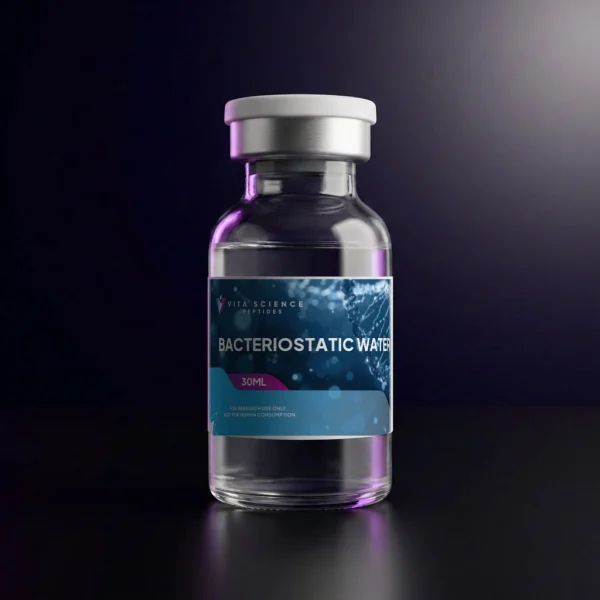
Our Sterile Bacteriostatic Water, 30 mL Multi-Dose Glass Vial is preserved with 0.9% benzyl alcohol and supplied in a 30 mL multi-dose glass vial. It is sold for laboratory use only.
Solvent comparison at the bench
| Solvent | Typical use | Notes |
|---|---|---|
| Sterile water | Freely soluble peptides, single-session stocks | No preservative; aliquot and freeze |
| Bacteriostatic water, 0.9% benzyl alcohol | Multi-draw laboratory stocks | Benzyl alcohol may interfere with some assays; confirm compatibility |
| Dilute acetic acid | Basic or poorly soluble sequences | Record molarity on the label; pH affects downstream work |
| DMSO, then aqueous buffer | Hydrophobic sequences | Keep the final DMSO fraction documented per assay |
Record the solvent identity, not just the volume. A stock described only as “1 mg/mL” is not traceable.
Working out solvent volume
Volume follows the target concentration and the vial content. The net peptide content is stated in the product name and description; the shipping weight on a listing is the packed weight for the courier and has no bearing on the calculation.
Sequence for a stock
- Read the net content from the label and the certificate of analysis for that lot.
- Choose a target concentration that matches the assay dilution series.
- Divide content by concentration to get solvent volume.
- Check that the volume fits the vial headspace before adding solvent.
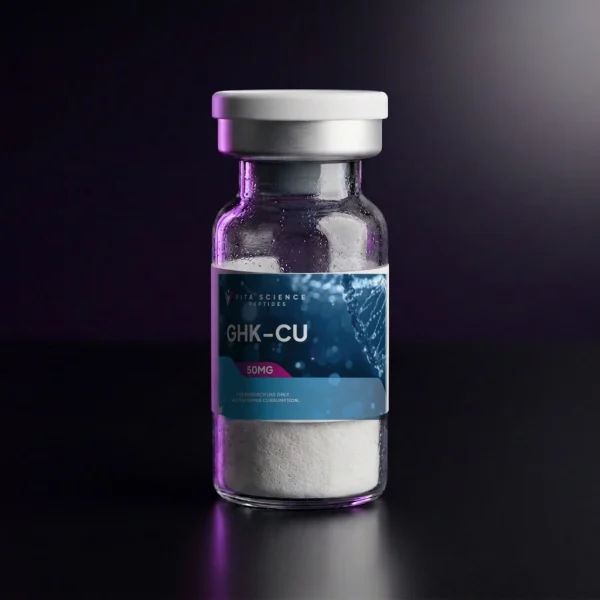
As a worked example, 50 mg of lyophilized powder brought to 10 mg/mL requires 5 mL of solvent. The 50 mg content of GHK-Cu Copper Tripeptide, 50 mg Lyophilized Vial is tested to ≥99% purity by HPLC, with a certificate of analysis per lot, so the nominal content can be used directly in that arithmetic.
Add solvent slowly down the vial wall. Allow the cake to dissolve without agitation. Do not vortex a peptide stock unless the protocol calls for it.
Glass vial compatibility
Borosilicate glass is the default container for aqueous and acidic peptide stocks. It resists the pH range used in most stock preparation and does not leach plasticizer into the solvent. Butyl stoppers hold up to repeated needle entry better than natural rubber.
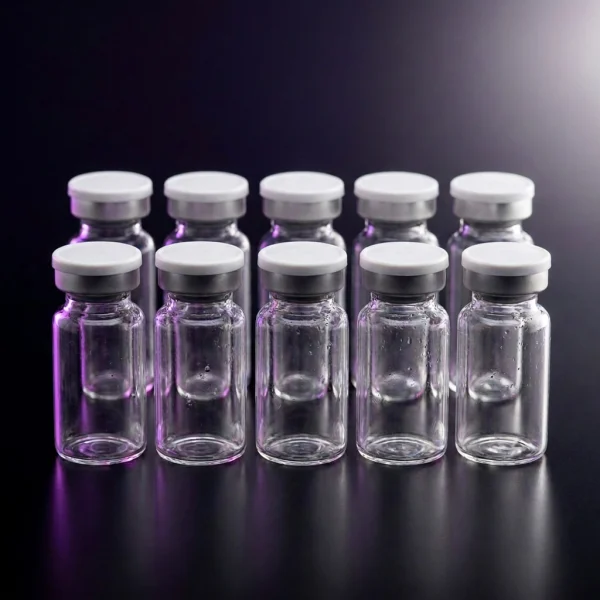
For aliquoting, our Sterile 10 mL Borosilicate Vials with Butyl Stoppers, Box of 10 are supplied ten per box with crimp seals, at $24.99 CAD. Ten vials allow a 50 mg stock to be split into small working aliquots so the parent stock is opened once.
Two compatibility notes. DMSO attacks some plastics, so keep DMSO-containing stocks in glass. Copper-containing peptides, GHK-Cu among them, should be kept away from chelating buffers unless the protocol accounts for the interaction.
Labelling a stock so it stays traceable
A stock label should reproduce everything a second researcher would need six months later. Write it before the solvent goes in, not after.
- Peptide identity as it appears on the certificate of analysis.
- Lot number from the vial label.
- Concentration and solvent, with figures and units — for example 10 mg/mL in bacteriostatic water.
- Date of preparation and the initials of the person who prepared it.
- Storage location and the freezer or fridge it belongs to.
Keep the downloadable certificate of analysis for that lot filed with the assay records. Identity, purity and test method are stated on it, which is what an audit asks for.
Storage after reconstitution
Lyophilized powder is the stable form. Once a peptide is in solution, treat the stock as a short-lived reagent and plan aliquots accordingly. Freeze-thaw cycling is the main avoidable stress, which is the argument for splitting a stock across several small vials rather than returning to one.
Store unopened lyophilized vials cold and dry, as stated on the product label. Our vials ship in cold-chain packaging with desiccant, tracked from Vancouver. Peptides are listed under /product-category/research-peptides/ and consumables under /product-category/lab-supplies/.
For laboratory research use only. Not for human or veterinary use.